AI agent + YOLO: a local computer-vision POC without training a model
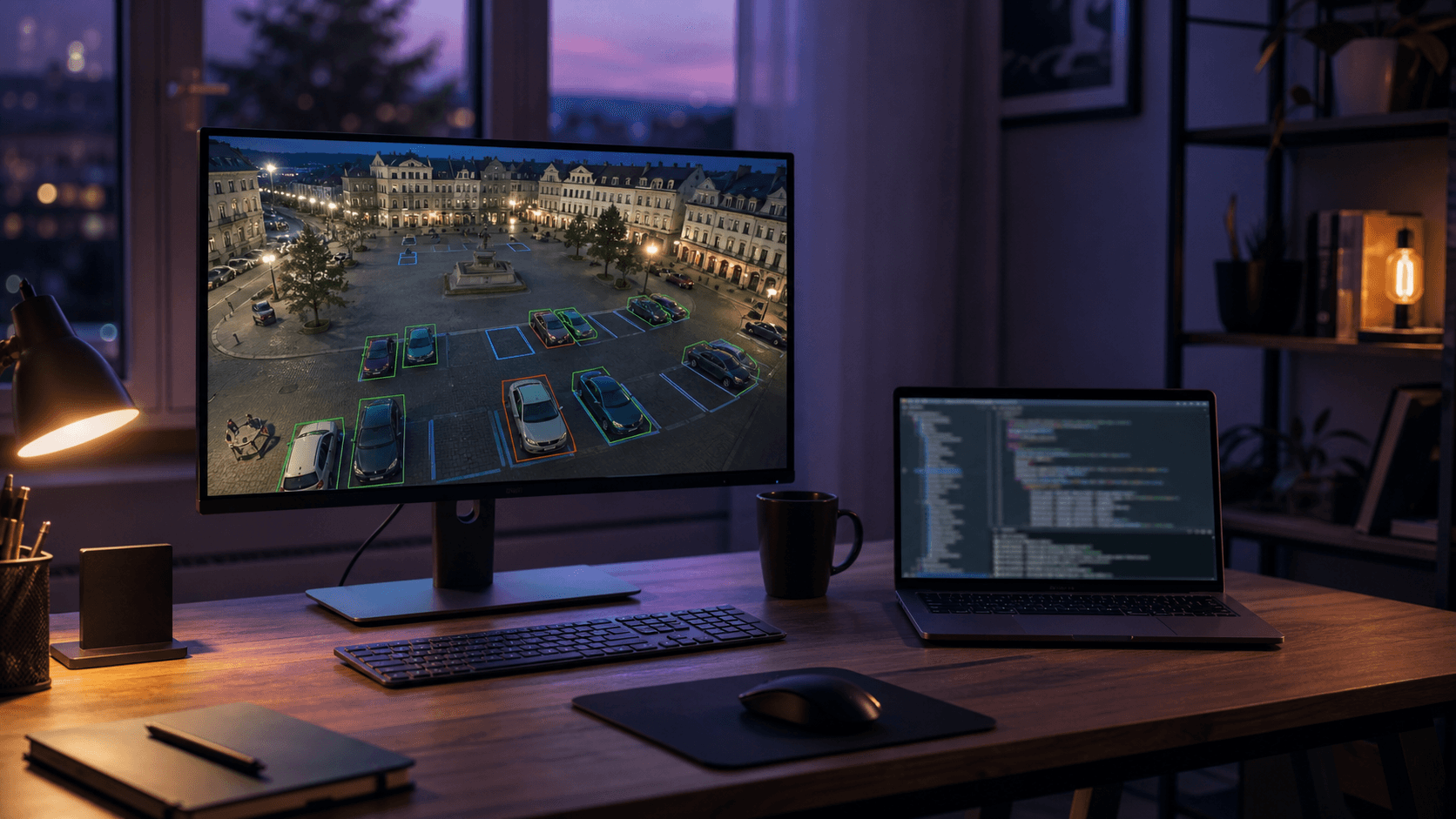
An AI agent does not have to end with text, email, or another internal dashboard. A practical example from AI s rozumem shows a more useful pattern: a coding agent received a public camera stream, inspected the scene, selected an existing vision model, and assembled a prototype that detects vehicles and evaluates parking-space occupancy.
The most important point is that the language model is not the production detector. It acts as a system integrator. It finds components, checks assumptions, writes the application, and connects a small specialist model to a usable interface.
What the agent actually did
The brief was short: count cars in a parking area, display the video stream, draw detection boxes, and distinguish free from occupied spaces. The source was a public livestream from a square in Hradec Králové.
Instead of blindly writing code, the agent first downloaded a frame and checked whether the camera was static, how large the vehicles were, and whether the view moved over time. It compared frames with a background difference and confirmed that most changes came from moving objects and foliage.
The resulting POC used an Ultralytics YOLO model for vehicle detection. It also included a simple interface for drawing the monitored area and individual parking spaces. The app overlays detections on the stream and evaluates occupancy from their overlap with the configured spaces.
Inference runs locally. In this demo, the internet connection is needed for the YouTube source stream, not for sending every frame to a multimodal API.
Why this pattern matters
An LLM is useful for the ambiguous layer between a goal and implementation: inspect the data source, choose a library, create configuration, assemble backend and UI, add diagnostics, and debug failures.
A smaller specialist model performs the repeated inference. That brings lower cost and latency, supports local or edge deployment, reduces data leaving company infrastructure, and produces a more predictable output for known object classes.
The same division of labour can support pallet counting in a warehouse, loading-bay occupancy, PPE checks, queue monitoring, or selecting uncertain frames for human review. The coding agent accelerates the first version; the detector handles routine inference.
A POC is not production
The video demonstrates a working prototype, not a finished municipal or enterprise system.
Production has to handle night, rain, shadows, snow, occlusion, camera drift, and objects outside the training distribution. Green boxes are not a quality metric. You need a labelled test set and measures that match the decision: per-space occupancy accuracy, false-free events, state-change latency, and stability over time.
Permissions and privacy also matter. A publicly accessible stream is not automatically free to process or republish for any purpose. With a company camera, resolve the legal basis, notices, retention, and data minimisation. If faces and licence plates are not needed, do not store them.
Licensing is another architecture decision. Ultralytics offers AGPL-3.0 and Enterprise licensing. A package installing successfully does not settle the terms for an internal or commercial deployment.
How I would scope a company pilot
Do not start with “build us an AI camera system.” Pick one measurable decision and one controlled image source.
For example:
- read one frame from a loading-bay camera every five seconds,
- detect vehicles only inside a configured zone,
- store state and confidence, not the original image,
- send uncertain frames to a human review queue,
- compare two weeks of output against a manual log,
- only then decide whether to integrate it into operations.
The agent can create the initial code, configuration editor, Docker image, tests, and audit dashboard. A person still approves the data source, metric, limits, and deployment.
Connecting it to automation
The detector output should not become another screen nobody watches. It can be a small structured event.
In n8n or Make, you can alert a dispatcher when a loading bay stays occupied, create a capacity report from hourly states, route uncertain frames for approval, open a maintenance task when the camera moves, or give an internal agent aggregated results without access to the original video.
That is where the value appears. Not because a model can draw a box, but because a limited, measured signal becomes part of an existing process.
My take
The interesting shift is not “vibe coding can now do computer vision.” It is the division of labour: a large model helps design and assemble the system, a small specialist model performs cheap repeated inference, and automation consumes only the resulting state.
That is a sensible path for company pilots. Start with a concrete decision, an existing model, and measured errors. The agent accelerates the POC, but production quality still depends on data, licensing, privacy, observability, and human review.
Sources: AI s rozumem: I built an AI app that monitors parking, Ultralytics documentation for stream prediction, object tracking, and YOLO licensing.