Claude Opus 4.8: a new top model for agents, coding, and long context

Claude Opus 4.8 was released on May 28, 2026, and it deserves its own article. Not because every new model is automatically a revolution, but because this one targets a very practical pain point: long agentic tasks, coding, research, tool use, and cases where it is better for a model to stop and admit uncertainty than to keep moving confidently in the wrong direction.
Short version: Opus 4.8 is not the model I would use as the default engine for every cheap workflow. For bulk email classification, simple extraction, lead tagging, or routine JSON transformation, it is too expensive. But if you are building an agent that needs to inspect a larger codebase, plan a change, use tools, compare sources, hold context, and avoid overconfident decisions, it becomes interesting.
What is new in Opus 4.8
In the official announcement, Anthropic says Opus 4.8 builds on Opus 4.7, improves across benchmarks, and is available at the same standard price. It also ships with three practical changes:
- user control over how much effort Claude puts into a task in Claude.ai,
- dynamic workflows in Claude Code for very large-scale problems,
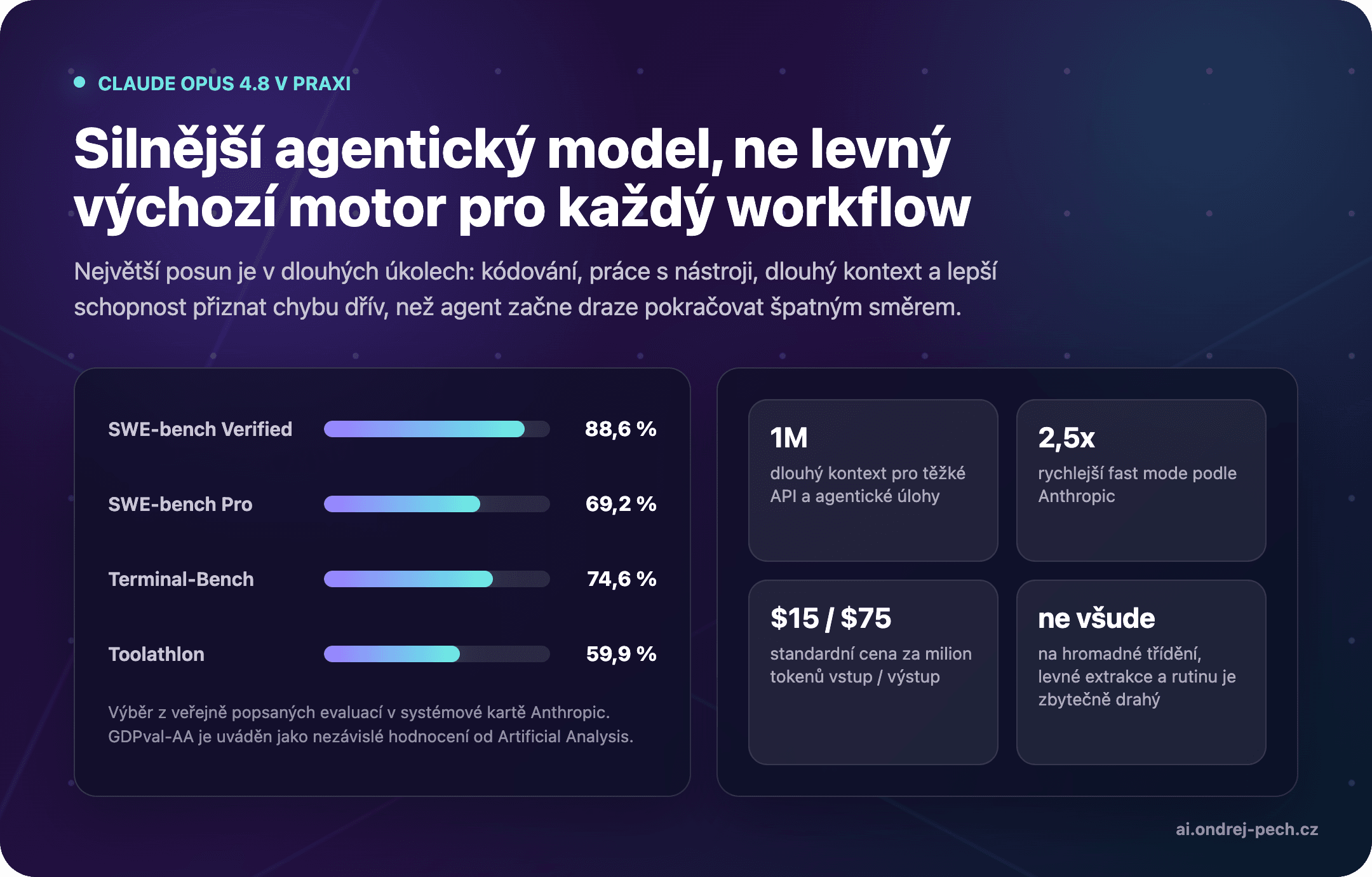
- fast mode for Opus 4.8, which Anthropic says can run up to 2.5x faster and is much cheaper than fast mode for previous models.
The Claude API documentation lists Opus 4.8 as an available Claude model. The current Anthropic model overview keeps it in the Opus pricing tier: 15 dollars per million input tokens and 75 dollars per million output tokens. That matters. This is not a cheap replacement for a Haiku or Sonnet layer. It is a specialist.
The real shift: agentic work
The most interesting part is not the benchmark table by itself. It is the behavior Anthropic describes in real agentic scenarios.
For Opus 4.8, Anthropic repeatedly emphasizes better judgment: the model should more often pause, ask, admit a mistake, or push back on a weak plan. That sounds soft, but for agents it is operationally hard.
If a model only writes a chat answer, a bad guess is annoying. If an agent edits a repository, calls tools, changes data, or runs overnight in a long loop, a bad guess costs money and time. A model that can say “I am not sure here” or “this plan is weak” can be more useful in practice than a model that scores a few points higher on a one-shot question.
Benchmarks: where it is strong
Anthropic’s system card shows strong results for Opus 4.8 especially in coding, long context, agentic search, tool use, and professional work.
Selected numbers:
| Area | Opus 4.8 result | Note |
|---|---|---|
| SWE-bench Verified | 88.6% | real GitHub issues |
| SWE-bench Pro | 69.2% | harder long-horizon coding tasks |
| SWE-bench Multilingual | 84.4% | 300 tasks across 9 languages |
| Terminal-Bench 2.1 | 74.6% | terminal tasks, Harbor leaderboard |
| Toolathlon | 59.9% Pass@1 | tool use in realistic applications |
| OSWorld-Verified | 83.4% | desktop environment control |
Important caveat: most of these figures are from Anthropic’s system card or evaluations described by Anthropic. The most interesting independent point is GDPval-AA from Artificial Analysis. According to the system card, Opus 4.8 leads GPT-5.5 xhigh by roughly 121 ELO points there, implying about a 66.7% pairwise win rate. This is the kind of benchmark I care about more than abstract trivia: documents, spreadsheets, slides, diagrams, and professional deliverables.
1M context: useful, but not magic
The system card frequently evaluates Opus 4.8 with up to a 1M token limit. On GraphWalks long-context tasks, the jump over 4.7 is visible:
| GraphWalks | Opus 4.8 | Opus 4.7 |
|---|---|---|
| BFS 256K | 85.9 | 76.9 |
| BFS 1M | 68.1 | 40.3 |
| Parents 256K | 99.3 | 93.6 |
| Parents 1M | 83.3 | 56.6 |
This does not mean you should throw a million tokens into every request. It means the boundary of what can be solved in a single agentic run moves: larger codebases, long legal or technical documents, project audits, and complex research across many sources.
Good workflow design still matters. Even with 1M context, I would keep retrieval, deduplication, intermediate summaries, checkpoints, and human approval for risky actions.
Dynamic workflows: when to actually turn them on
Tomáš’s new video on Dynamic Workflows captures the practical point well: this is not just another performance toggle. Dynamic workflows in Claude Code mean Claude can first plan the task, split it across tens to hundreds of parallel subagents, have parts independently checked, and only then merge the result back together.
According to Anthropic’s official article, workflows have been available since May 28, 2026 as a research preview in the Claude Code CLI, desktop app, and VS Code extension for Max, Team, and Enterprise plans when enabled by an admin. In Max/Team environments and through the API they are on by default; in Enterprise they start disabled and must be enabled by an administrator.
In practice, I would use them mainly for work that naturally splits into pieces:
- a large bug hunt across an entire repository,
- a framework or API migration touching hundreds of files,
- dead-code, performance, or security-pattern audits,
- refactoring where I want independent review of multiple approaches,
- expensive work where it is worth having the result challenged and verified.
I would not use them for small changes like “edit one component”, a simple prompt, or a routine fix. Anthropic explicitly warns that dynamic workflows can consume substantially more tokens than a typical Claude Code session. The first workflow should show the user what is about to run and ask for confirmation. For teams, that is a good reason to set budgets, start with tightly scoped tasks, and avoid treating ultracode as the default answer to every problem.
My rule: turn on a dynamic workflow when you would normally split the work across multiple people or reviewers. If one developer could handle it in one file, it is probably an unnecessarily expensive hammer.
Where I would use it
1. A senior coding agent
A larger repository, a non-trivial bug, several services, and an agent that must understand the system before touching it. Opus 4.8 makes sense as the planning and intervention model: read context, propose a plan, evaluate risk, make the change, and explain it.
I would not use it for routine boilerplate. A cheaper model is enough there.
2. A research agent with tools
When an agent searches, opens sources, compares claims, writes a synthesis, and must separate verified facts from assumptions, Opus 4.8 is a good candidate. Better judgment and willingness to admit uncertainty matter here.
This is exactly the kind of layer I would use for final synthesis after cheaper data collection.
3. Expensive decisions in a workflow
Example: an automation processes an invoice, contract, or technical incident. A cheaper model performs the first extraction and checks. Opus 4.8 comes in only when the case is unclear, expensive, or sensitive.
That is where it makes economic sense: not as the default, but as an escalation specialist.
4. Review of other agents’ work
In multi-agent systems, Opus 4.8 is interesting as a reviewer. Cheaper agents prepare options, Opus 4.8 checks them, finds weak spots, chooses the best option, and marks where a human should decide.
Where I would be careful
Price
The Opus tier is expensive. If a workflow calls the model thousands of times per day, you need a very clear reason for using Opus there. Otherwise the bill moves fast.
Fast mode is not always the answer
Fast mode sounds excellent, but I would test it separately. Some tasks need speed. Others need maximum reliability. If an agent is making a costly code change or summarizing legal documents, speed may not be the main metric.
Multilingual is not the absolute leader
The system card says Opus 4.8 is the strongest generally available Claude model on multilingual benchmarks, but it still trails Gemini 3.1 Pro and GPT-5.4. I would test it for Czech content, but I would not automatically pick it as the best model for high-volume localization.
Agentic safety
Anthropic reports improvements in some safety areas, but also says Opus 4.8 is less robust than Opus 4.7 in several agentic contexts, including prompt injection scenarios. For production agents this means the usual discipline: sandboxing, limited permissions, logging, budgets, checkpoints, and human approval for irreversible actions.
How I would set it up
The sensible architecture is not “Opus 4.8 everywhere”. It is more like three layers:
- A cheap model for routine classification, tagging, simple extraction, and data normalization.
- A Sonnet-class middle layer for normal generation, structured outputs, and standard agentic steps.
- Opus 4.8 for unclear, expensive, long, or risky cases.
In prompts, I would explicitly require it to separate what it knows, what it assumes, what needs verification, and when it should stop. For agents, I would add a budget, a checklist, and a rule that destructive actions first require a plan.
Verdict
Claude Opus 4.8 is a strong release. Not because “new model” is magic, but because it moves the areas that currently limit practical AI agents: long context, coding, tool use, professional work, and the ability not to behave like an overconfident bulldozer.
I would not put it into every ordinary automation. I would use it for the expensive decision layer, senior coding agents, and final research synthesis. In those places it can justify its price.