Codex in the lab: an AI agent controls measurements, not just software
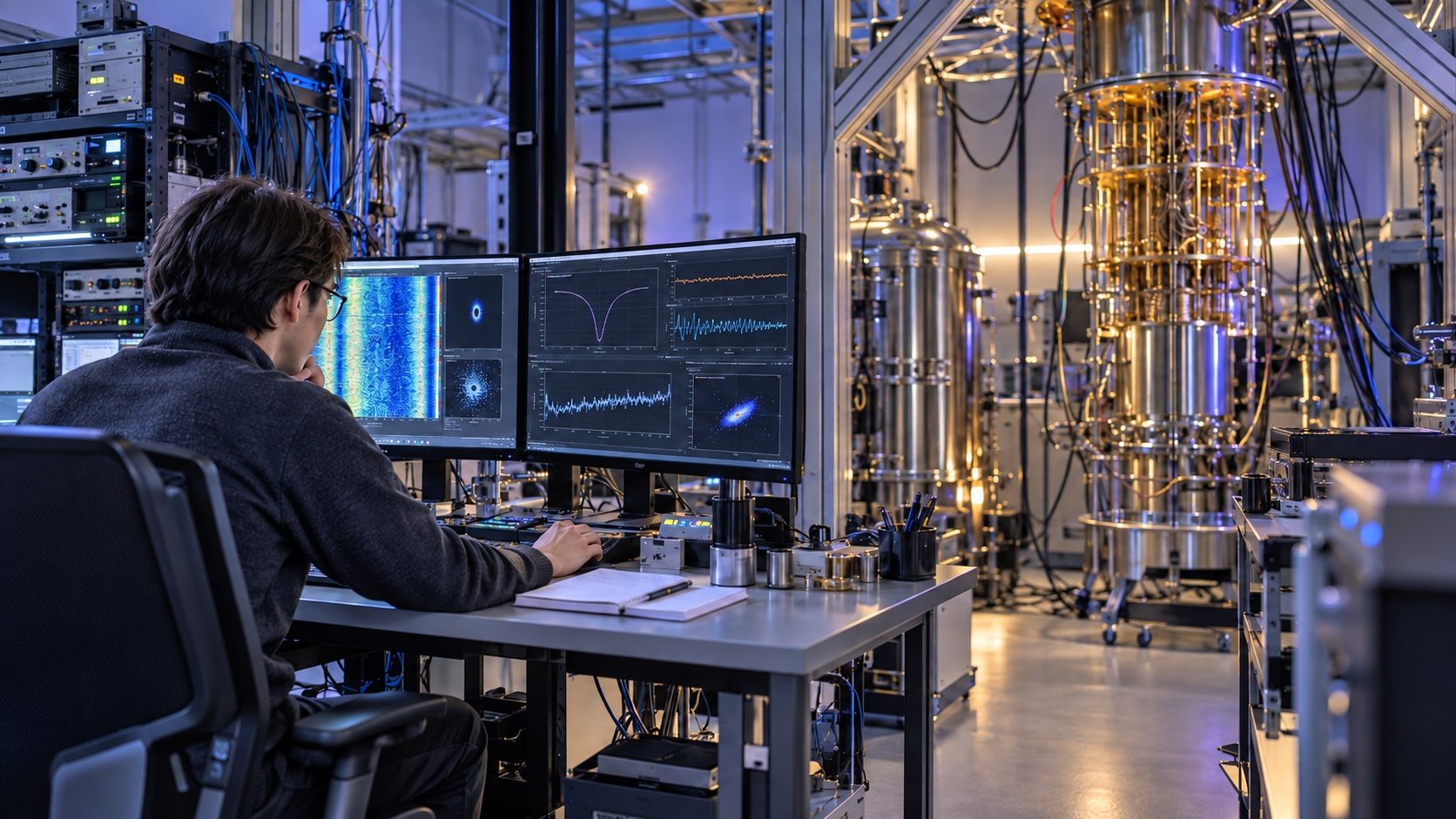
The most interesting AI automation this week is not a chatbot or another app generator. Researchers at MIT EQuS connected Codex with GPT-5.6 Sol to software that controls measurements on real quantum chips. The agent selected parameters, operated instruments, analysed plots, stored calibrations, and decided whether to refine a measurement or continue.
The transferable pattern is more important than the quantum hardware: the agent closes a loop between action, telemetry, evaluation, and the next step. The same architecture appears in manufacturing inspection, laboratory automation, infrastructure operations, and document workflows. The difference is that a bad action on physical equipment cannot always be reversed with Undo.
What MIT actually tested
The case study describes a previously unmeasured six-qubit chip: four fixed-frequency and two tunable qubits. The agent ran through Codex with GPT-5.6 Sol at Ultra reasoning and used the group’s existing Jupyter orchestration software through a simple in-house MCP.
It received more than chat instructions. The context included live measurement parameters, programs, plots, raw data, logs, a results database, and the orchestration source code. Researchers created measurement-specific skills containing prerequisites, template code, parameter guidance, common physical failure modes, and examples of successful and failed plots.
That preparation is a central part of the result. The team says it took several months of iteration to identify the right context and skills. The agent was not magically competent out of the box; it was embedded into an existing software process and given concrete operational knowledge.
The result: 36 of 40 without intervention, with clear limits
The agent found all six resonators and suitable initial readout powers. Across 40 target measurements on the four fixed-frequency qubits, researchers intervened to improve only four. A separate automated loop ran for 12 hours overnight, collected 200 measurements, and was followed by agent investigation of failed points.
Weak signals exposed the boundary. On tunable qubits, the agent needed substantial guidance from an experienced researcher, sometimes pursued the wrong explanation, and once marked an inadequate result as acceptable. The authors also report that agents were anecdotally slower than experts. Physical acquisition takes seconds to tens of minutes and runs serially, so an agent swarm cannot brute-force the bottleneck in parallel.
This is not “AI replaced the scientist.” The agent absorbed a well-described routine and freed researchers to focus on experiment design and ambiguous physical behaviour. That is where autonomy is useful today.
A closed-loop architecture
I would split a similar production system into six layers:
- A fixed state machine defines allowed stages and transitions.
- Skills document parameters, dependencies, known failures, and examples of success and failure.
- The agent selects the next measurement or diagnostic step inside a bounded action space.
- Deterministic checks validate ranges, fit quality, required data, and technical limits.
- Stop conditions interrupt the run on unusual noise, drift, repetition, or budget overrun.
- A human decides ambiguous cases and approves actions that could damage equipment, data, or downstream operations.
Every step needs an audit trail: starting state, skill and model version, tool, parameters, raw data, interpretation, reason to continue, and human intervention. Without it, an incident cannot be reproduced and the evaluation cannot improve.
What to transfer into an ordinary company
Start with a process that is already controlled through software and has measurable feedback. In manufacturing, let the agent assess an image and request a repeat measurement, not autonomously reconfigure the machine. In IT operations, let it collect logs, run a diagnostic, and recommend a playbook before it can restart a critical service. For invoices, let it extract data, reconcile against a purchase order, and request a missing document—not send payment.
In n8n or Make, the agent should not be one giant “solve this case” step. The orchestrator should own state and permissions, each tool should expose a narrow contract, and a validator should decide whether the workflow can proceed. The agent is an adaptive layer inside the process, not a substitute for the process.
A sensible pilot moves through stages:
- shadow mode on historical cases,
- proposed actions without permission to execute them,
- limited autonomy for reversible, low-risk actions,
- mandatory escalation on weak signals or conflicting rules,
- measurement of human time, interventions, incorrect actions, and cost per correctly completed run.
What this case does not prove
This is a joint MIT/OpenAI case study on a relatively simple benchmark chip, not an independent comparison of several models. It reports concrete measurement and intervention counts, but not a full economic analysis or a precise time saving. More complex and novel experiments may require substantially more human intuition.
It is still stronger deployment evidence than most agent demos. The agent worked with live telemetry, controlled existing tools, operated overnight, and encountered failures that the authors described openly. The combination of successful routine work and visible limits is exactly what makes the case useful.
Sources: OpenAI: How GPT-5.6 Sol helps run quantum computing experiments and the MIT/OpenAI technical case study Agentic Calibration of Superconducting Qubits.