Gemini 3.5 Flash: a fast worker model that deserves its own article

Google released Gemini 3.5 Flash at I/O on 19 May 2026. I think it deserves a separate article, not just a paragraph inside a general Google I/O roundup.
The reason is simple: 3.5 Flash is not just another model-table entry. It is the kind of model that can change the architecture of everyday AI automation: smart enough, very fast and useful as a working layer for repeated API calls, agents, routing, extraction and multimodal inputs.
At the same time, I would not hand everything to it without measurement. Independent benchmarks show strong agentic performance and very good speed, but also a higher price compared with the previous Flash model and areas where it still makes sense to escalate to a Pro model, a specialist model or a human.
What Google actually released
Gemini 3.5 Flash is the first model in the Gemini 3.5 family. Google positions it around agents, coding, fast UI generation, tool use and multimodal input.
Key practical details:
- available in the Gemini API through Google AI Studio and Android Studio,
- also available in Google Antigravity, Gemini Enterprise and the Gemini app,
- 1 million token context window,
- input: text, image, video and speech,
- output: text,
- paid API pricing: $1.50 per 1M input tokens and $9 per 1M output tokens including thinking tokens,
- cached input: $0.15 per 1M tokens plus storage.
With a chat model, the main question is often whether the answer was good. With an API model, you also care about cost across thousands of calls, latency, output validation, fallbacks, long-context behavior and whether the model can keep a tool workflow on track.
What independent benchmarks say
Google has its own benchmarks and demos. They help explain the direction. For comparisons with other models, I put more weight on independent sources.
Artificial Analysis measured Gemini 3.5 Flash at 55 on its Intelligence Index, 9 points above Gemini 3 Flash. Their analysis places it ahead of Grok 4.3 high and Claude Sonnet 4.6 max. They also report output speed around 284 tokens per second. In API work, speed matters because it decides whether AI can be used in an interactive tool, an internal agent or a workflow that needs to finish quickly.
The agentic results are especially strong. Artificial Analysis reports GDPval-AA at 1656 Elo, just behind GPT-5.4 xhigh at 1674. BenchLM gives Gemini 3.5 Flash an agentic score of 97.3 and ranks it #3 out of 116 models. To me, that is the most important signal in this release.
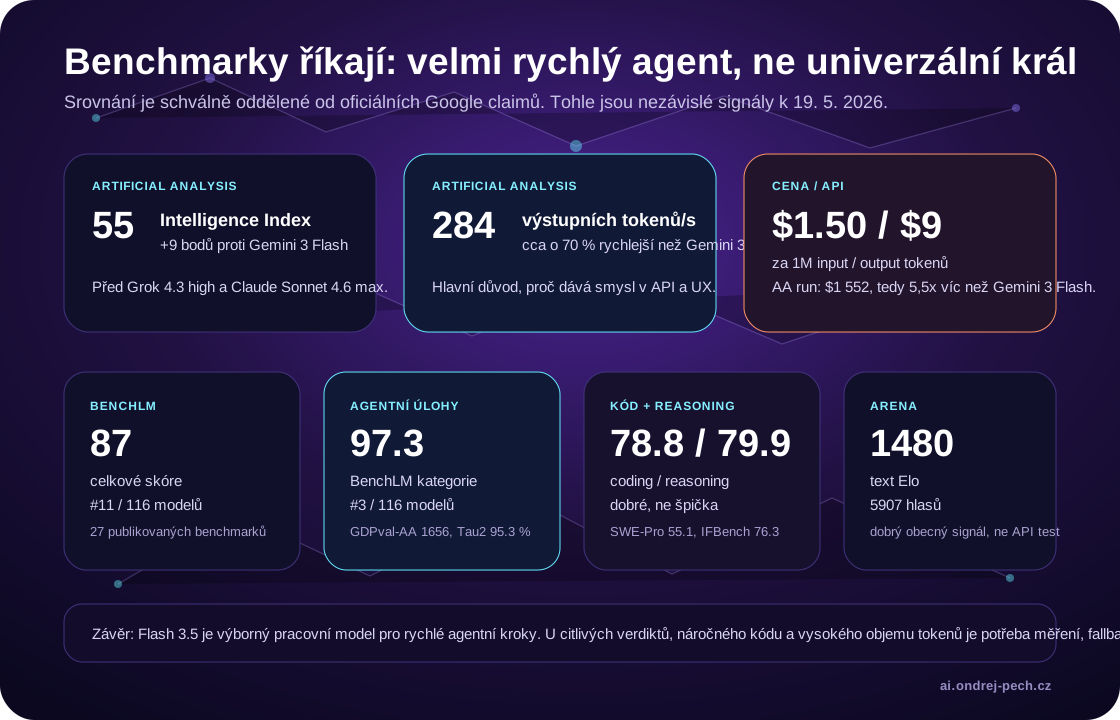
BenchLM also gives a more sober view. Overall, Gemini 3.5 Flash scores 87 and ranks #11 out of 116 models, but it ranks #23 in coding and #37 in instruction following. That does not mean it cannot code. It means it is not automatically the best choice for every refactor, architecture decision or long instruction-heavy prompt.
Arena is a decent general signal too: BenchLM lists text Elo around 1480 from 5907 votes. I would treat that as a useful preference signal, not as a replacement for API tests on a real workflow.
Where it is genuinely strong
The first strength is speed. If you are building an internal tool that should respond within seconds, a fast model often beats a slightly smarter model that is slower and more expensive. For email triage, support tickets, CRM enrichment or document preprocessing, you often need a reliable first pass more than the absolute best reasoning.
The second strength is agentic work. Google positions the model around Antigravity, subagents, tool use and long-running workflows. Independent numbers from Artificial Analysis and BenchLM support that direction: it looks like a good engine for repeated planning, tool calls and iteration.
The third strength is multimodality. Google lists text, image, video and speech input. Artificial Analysis shows strong multimodal results, including MMMU-Pro around 84%. In practice, that may make it useful for invoices, screenshots, documents, simple video analysis or internal workflows where the input is not just clean text.
Where I would be careful
The first catch is price. Gemini 3.5 Flash is still cheaper than large frontier models, but it is more expensive than Gemini 3 Flash. Artificial Analysis reports that running their Intelligence Index cost $1,552, 5.5x more than Gemini 3 Flash. At high volume, poor architecture gets expensive quickly.
The second catch is factual accuracy. Artificial Analysis reports a much lower AA-Omniscience hallucination rate than Gemini 3 Flash, but still around 60.7%. That is an improvement, not a reason to turn off verification. If the answer needs to be factually reliable, you still need citations, retrieval, source checks or validation.
The third catch is coding and instruction following. It may be excellent for smaller UI pieces, migrations, suggested changes or agentic iteration. For final architecture, security changes, complex refactors and code review, I would still keep a stronger model or a human in the loop.
How I would deploy it
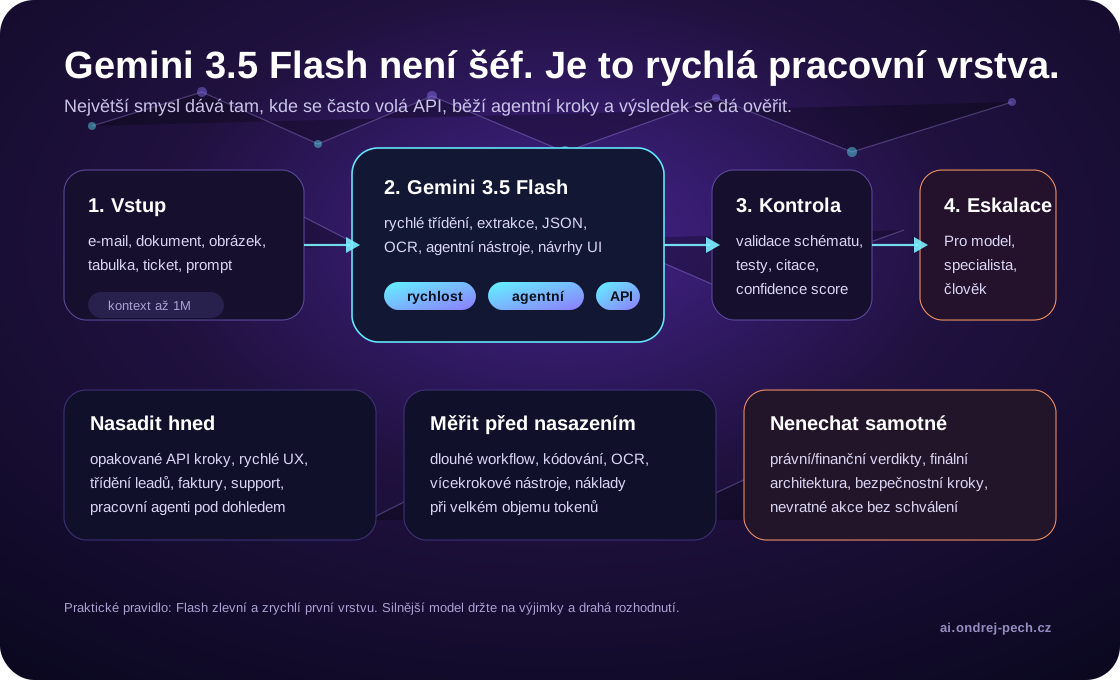
Not as one model for everything. More like a first working layer:
- Gemini 3.5 Flash processes the input: email, document, ticket, screenshot or text.
- It returns structured JSON: task type, priority, extracted data, risks and recommended next action.
- Automatic validation checks schema, empty fields, limits and rules.
- Simple cases are resolved directly.
- Ambiguous or expensive cases are escalated to a stronger model or a human.
Concrete examples:
- sorting support tickets by problem type, priority and team,
- extracting data from invoices, orders and contract attachments,
- pre-filling CRM records from email communication,
- quick document summaries before a meeting,
- checking screenshots and simple visual inputs,
- drafting replies that a human approves,
- agentic steps in n8n or Make where Flash prepares the plan and tools perform the actions.
The important part is to measure your own dataset. If you have 500 real tickets, 100 invoices or 50 typical emails, run a small eval: extraction accuracy, human corrections, average cost per case, latency and escalation rate.
When to use Flash and when not to
I would consider Gemini 3.5 Flash as a default candidate for fast API layers, agentic operations, multimodal preprocessing and routine business automation.
I would not use it alone for final legal or financial decisions, production security changes, complex architecture decisions or workflows where a mistake triggers an irreversible action. Those need validation, fallback and a human.
If you already use a cheaper Flash model and it works, I would not switch everything blindly. 3.5 Flash is smarter and faster, but also more expensive. The best migration is to pick the tasks where the older Flash model failed or where you need stronger agentic behavior, and measure the difference there.
Bottom line
Gemini 3.5 Flash is, in my view, one of the most important Google I/O 2026 announcements. Not because it is “the best model in the world”, but because it fits where AI applications are going: from one chat window to layers of fast worker models, validation, tools and escalation.
If you build automations, it is worth testing, especially for agentic workflows, fast API responses and multimodal inputs. I just would not treat it as a replacement for measurement. The benchmarks show a very strong model, but they also say clearly that cost, hard coding, instruction following and factual reliability still depend on the architecture around the model.
Sources: Google: Gemini 3.5 - frontier intelligence with action, Google AI for Developers: Gemini API pricing, Google DeepMind: Gemini 3.5 Flash model card, Artificial Analysis: Gemini 3.5 Flash analysis, Artificial Analysis: Gemini 3.5 Flash model page, BenchLM: Gemini 3.5 Flash benchmarks, Arena text leaderboard.