Google ARTEMIS: an AI agent tests Android on a real phone
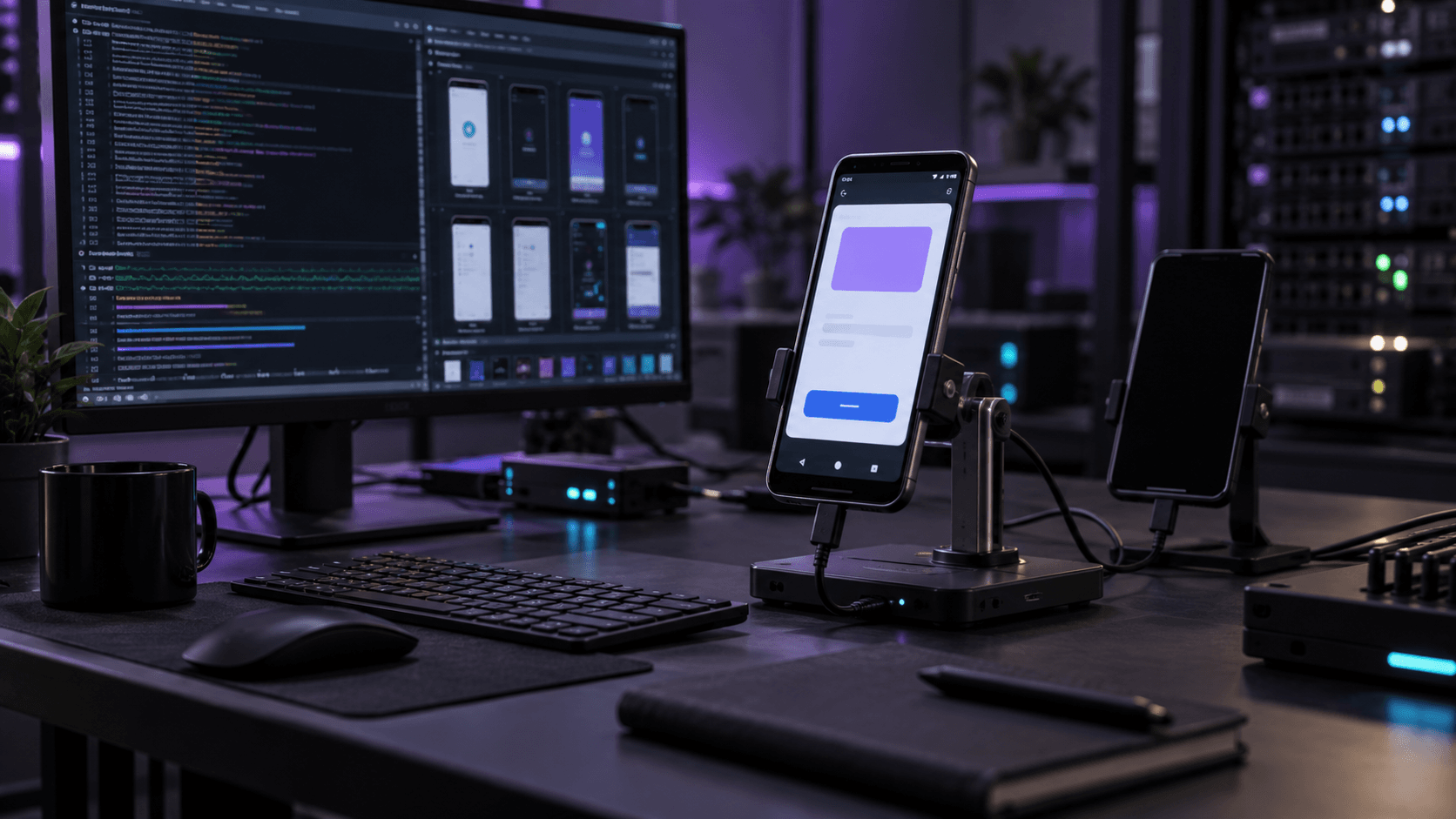
Google has opened an interesting gap between coding agents and mobile QA. The open-source ARTEMIS project takes a natural-language test, connects to an Android phone or emulator, drives the app, collects screenshots and Logcat, and returns a structured report.
That is more useful than an agent that merely writes an Espresso test and declares the work finished. Mobile apps fail on system dialogs, permissions, keyboards, slow loading, custom Compose or Flutter controls, and runtime states that are not visible in source code. ARTEMIS puts the agent inside the feedback loop between code and a real device.
The repository is new and moving quickly. Google added its own Accessibility Helper for more reliable UI hierarchy capture on September 10 and continued with a playground backend on September 11. I would treat it as a promising open-source foundation for a pilot, not a finished enterprise testing platform.
How ARTEMIS works
A Python service and web console run on the development machine. ARTEMIS connects to an Android device or emulator through ADB, builds the current state from the screen and UI hierarchy, and lets the agent choose the next action. When normal accessibility elements are insufficient, it falls back to OCR and visual targeting for custom Canvas, Compose, or Flutter interfaces.
The built-in MCP server is the important part for coding agents. Codex, Claude Code, Antigravity, or Windsurf do not need another dashboard. They receive narrow tools for starting a task, reading device state, managing a run, diagnosing the environment, and inspecting traces. After changing code, an agent can build an APK, install it, execute a specific scenario, and attach screenshots and logs to the result.
ARTEMIS provides two execution profiles:
- Flash is a fast reactive loop documented at roughly 3–5 seconds per step. It has no plan, checkpoints, pre-execution safety net, or final report, and its default turn count is unlimited.
- Pro uses a Planner, Operator, and read-only Checker. It validates each action against the UI tree or pixels, maintains a living plan, and can verify checkpoints. A step is documented at roughly 15–40 seconds.
The split is sensible. Flash suits inexpensive smoke tests with a clear outcome. Pro belongs on longer exploration, reproduction of an unstable bug, or any scenario where evidence matters more than speed.
Where it fits in a development team
The best first deployment is not “test the entire app.” It is one concrete flow that somebody repeatedly executes by hand:
- clean installation, onboarding, and permission prompts,
- login with a test account and detection of unexpected popups,
- bug reproduction from support steps,
- purchase-flow verification against a sandbox backend without a real payment,
- behaviour under a slow network or after returning from the background,
- collecting screenshots, Logcat, and timings for a Jira or GitHub issue.
I would not use ARTEMIS as a replacement for deterministic unit and instrumentation tests in CI. Put it after the build and basic suite as an adaptive layer. Fixed tests catch known regressions quickly; the agent attempts a longer end-to-end journey, tolerates minor layout changes, and gathers evidence for a human.
A practical pipeline looks like this:
- CI builds the APK and prepares an isolated emulator or device.
- A test backend seeds known data and an account without real privileges.
- The agent receives a scenario with an explicit goal, prohibited actions, and ‘assert’ conditions.
- ARTEMIS executes the flow and stores the trace, screenshots, logs, and final state.
- A deterministic checker decides pass or fail; the agent’s prose report is supporting evidence.
- A failure creates a review artifact but never deploys anything to production by itself.
A 99% score is not permission to switch off QA
ARTEMIS reports more than 99% completion on AndroidWorld, Google Research’s benchmark of 116 parameterised tasks across 20 apps. It is an interesting signal, but the number comes from the project authors, and the repository does not yet offer a stable release or an independent comparison on your applications.
AndroidWorld also evaluates precisely defined tasks with state-based reward functions. A company app has custom controls, translations, backend latency, biometrics, push notifications, and failure modes that no public benchmark covers. The useful metric is not a README score. It is the share of your scenarios completed without intervention, false pass and false fail rates, time to reproduce a bug, and cost per useful report.
Security: a test phone is still a privileged computer
ARTEMIS installs an Accessibility Helper that reads the UI hierarchy. Its documentation says the helper itself listens only on the phone, but the system also handles screenshots, OCR, logs, and the selected model backend. I would not place a personal phone or production account in the first pilot.
The minimum operating baseline is:
- a dedicated device or emulator without personal data,
- a test tenant, synthetic contacts, and sandbox payment rails,
- restricted ADB and network permissions,
- no OTPs, production API keys, or customer screenshots in prompts,
- a maximum turn count and time limit even for Flash,
- prohibited system actions and human approval before installs, deletion, or purchases,
- trace retention without secrets and with a defined retention period.
Screen content is input to the agent. A tested webview, chat, or document can contain prompt injection. The coding agent must never treat screen instructions as fresh authority. Run policy needs higher priority, and the tool layer must enforce allowed actions.
The useful takeaway
ARTEMIS does not prove that mobile QA can go home. It proves that a coding agent can have eyes, hands, and diagnostics on a real Android device. That closes the most expensive gap in agentic development: the model no longer has to stop after changing code; it can verify what the application actually did.
Start with one stable smoke scenario on an isolated emulator. If the agent repeatedly produces the correct pass/fail result, a useful trace, and measurable time savings, then add real devices, more apps, and exploratory tests. Autonomy in QA is valuable only when it leaves reproducible evidence behind.
Sources: Jirka Hernik’s YouTube signal 10,000 agents and 88 hours, Google ARTEMIS repository and documentation, current ARTEMIS commit history, Google Research AndroidWorld, and its open-source benchmark environment.