Google DeepMind Decoupled DiLoCo: AI training is starting to look more like cloud infrastructure

Google DeepMind published Decoupled DiLoCo on April 23, 2026. This is not another chatbot release. It is infrastructure research, and that makes it interesting.
What DiLoCo is
DiLoCo stands for Distributed Low-Communication training. In simple terms, instead of training one large model on one tightly connected supercluster, the work can be split across separate groups of accelerators.
Those groups train locally and synchronize only periodically. The goal is to reduce communication requirements and make training possible across less perfectly connected infrastructure.
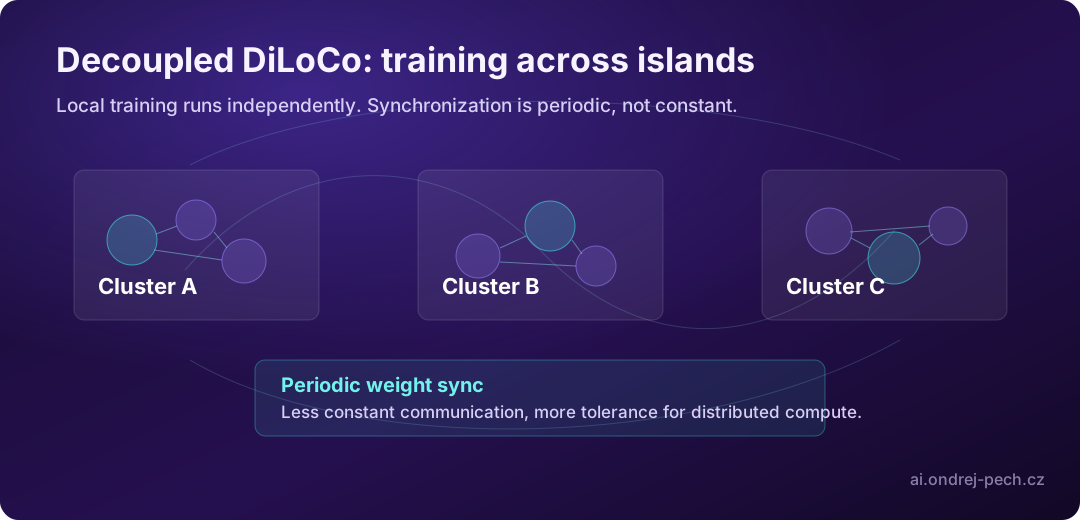
Decoupled DiLoCo pushes that idea further by separating parts of training so the system can better handle different clusters, failures and asynchronous work.
Why it matters
Frontier model training depends on extremely expensive and tightly connected hardware. That creates bottlenecks: limited capacity, painful failures, high cost and strong centralization.
If large-model training can be split more robustly across clusters, the economics and resilience change.
What it means for companies
Most companies will not train a frontier model because of Decoupled DiLoCo. That is not the point. The point is that AI infrastructure is becoming more cloud-like: distributed, resilient and better at using available hardware.
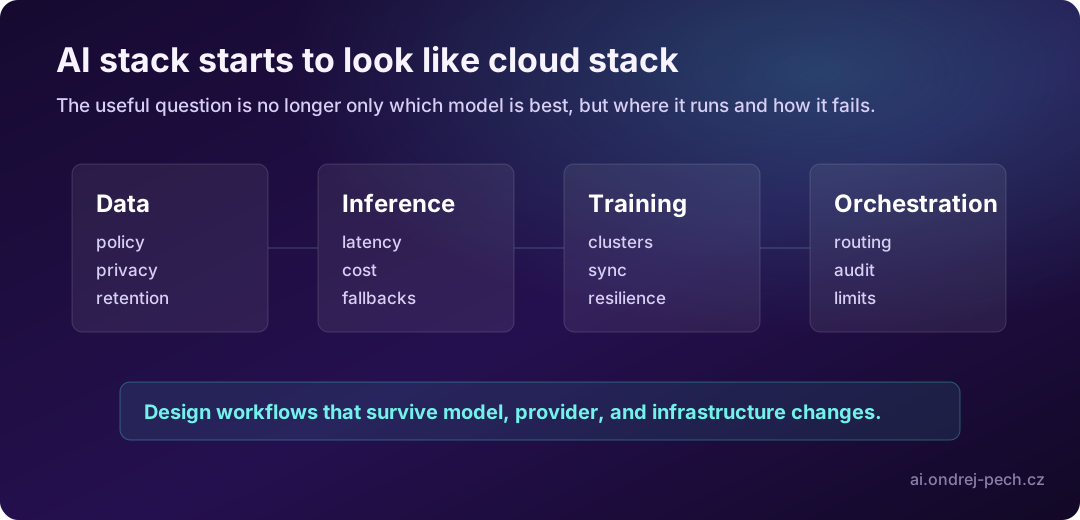
Long term, this can mean cheaper training and fine-tuning, better use of regional hardware, stronger failure tolerance, and less dependence on one giant data center.
Practical lesson
For normal companies, the lesson is architectural: avoid vendor lock-in as your only strategy, separate data, inference and orchestration, track cost and quality, and design workflows that can survive a model or provider change.
Conclusion
Decoupled DiLoCo is not something you enable in n8n tomorrow. It is a research signal about where large-model infrastructure is going. AI stacks will increasingly look like cloud stacks: you need to know where the model runs, what it costs, how it scales and what happens when part of the system fails.
Sources: Google DeepMind: Decoupled DiLoCo, paper, Marek Bartoš, AI ta Krajta.