Grok Build: Xai now has its own terminal coding agent

xAI introduced Grok Build on May 14, 2026: an early beta coding agent that runs directly in the terminal. It is aimed at professional software engineering, more complex coding tasks, and workflow automation.
At first glance, this is xAI's answer to Claude Code, Codex CLI, and other developer agents. The bigger point is that coding agents are becoming their own product category. This is no longer just a chat that explains a function. It is a tool that can plan, edit files, run commands, show diffs, and work inside a repository like a junior colleague under review.
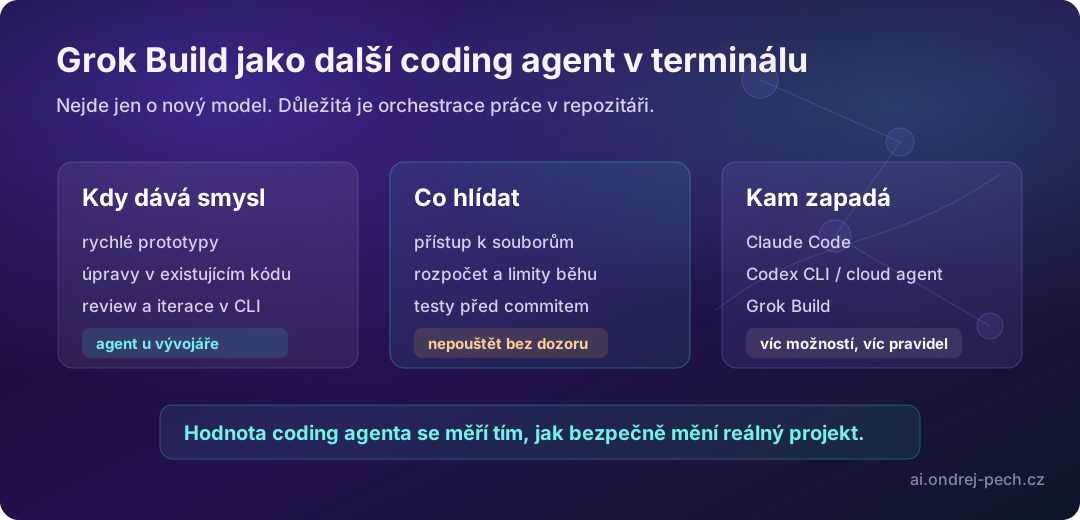
What Grok Build promises
According to xAI, Grok Build runs as a CLI inside a local project. The key feature is the planning mode: for more complex tasks, the agent should propose a plan first. The developer can approve it, comment on individual steps, or change the plan before the agent starts working.
That is the right direction. With coding agents, I do not only want the final output. I want to see intent, risks, and changes before they touch the project. If an agent edits real code, diffs, tests, and review must be part of the natural workflow.
The update: workflows for larger jobs, not another terminal chat
In July, xAI open-sourced Grok Build and added Workflows. From a task description, the agent can build an orchestration: split work into phases, dispatch specialist agents, include independent verification, then return one report. A workflow can be saved in the repository and rerun as a team command.
That matters more in practice than another benchmark. A one-off agent can fix a bug. A repeatable process such as “review every PR for missing authorization, send findings through a second verification step, and produce a prioritised report” needs stable structure, guardrails, and repeatable output.
I would not turn this into an autonomous merge factory. Start with bounded jobs whose outputs are easy to verify: a split repository audit, triage of many issues, test-plan proposals, or checking documentation against an API. Each phase needs least-privilege access, a budget, and a human checkpoint.
The open-source agent loop is not automatically an advantage either. It does make it possible to inspect context assembly and tool dispatch, then add company-specific guardrails. For an internal platform, that can be more valuable than blindly trusting another closed CLI.
Why this matters beyond xAI
Grok Build confirms that coding agents are splitting into several layers:
- editor assistants such as Cursor,
- terminal agents such as Claude Code, Codex CLI, and Grok Build,
- cloud agents that work on issues or pull requests away from the local machine,
- internal company agents connected to specific repositories and processes.
For developers, this is healthy pressure. Competition in this category should improve planning, repository understanding, test execution, and safer approval flows.
What I would watch
Every coding agent needs three guardrails.
First: access to files and commands. A terminal agent is much stronger than a chatbot because it can actually change things. That is useful only when the boundaries are clear.
Second: cost and limits. Parallel workflows multiply both spend and tool actions. A production setup needs a maximum agent count, time limit, cost cap, and a clear handoff rule for human review.
Third: decision quality. Simple edits may feel magical. Larger changes need strong context, precise instructions, tests, and a human who understands the result.
Practical takeaway
I would not treat Grok Build as a reason to replace the whole development stack. The new workflows are a reason to watch it as a building block for repeatable agent work.
Whether you use Claude Code, Codex, or Grok Build, the rule is the same: the agent can write and propose, but production responsibility belongs to the workflow. Plan, diff, tests, review, limits.
Sources: xAI: Introducing Grok Build, xAI: Grok Build is Now Open Source, xAI: Workflows in Grok Build, xAI Docs: Grok 4.5, Jirka Herník: Opus 5, Grok 4.5 a velká brzda.