Meta Ray-Ban Display: from web apps to Muse and field workflows
September 25, 2026 update: what Connect changes for work
Marek Bartoš’s September 24 video highlighted new glasses and Muse. The announcements were made at Connect on September 23; Meta published its recap on September 24. These are not releases from today.
Meta announced Explore for discovering apps, calendar actions available in English in the US, and notification mirroring to come. The sales expansion names the UK, Canada, France, Italy and Germany, not Czechia. Official Display update.
Muse is due on AI glasses in the coming months. Meta also lists Notion, Granola, GitHub and Box work connectors, and plans an email address for the agent. This does not establish an API for your n8n workflow. Connect recap.
Start with one field-service step
My proposed pilot: a technician confirms a checklist item, the backend retrieves the job and drafts a CRM update. The glasses show only the next step and any discrepancy. The technician approves the record; the customer email stays a draft. This is a proposed architecture for a custom app, not a claim that Muse already ships this integration.
In n8n or Make, I would track the job identifier, approval state and duplicate-write protection. The audit record needs the input, proposed change, approving person and outcome. Start with synthetic jobs and measure corrections, interruptions and completion time.
Choose a pilot around hardware, features and permissions actually available in the target country. Until the specific integration is confirmed, a keynote is not enough to commit to a production date.
Original context from May 2026
The section below preserves the developer announcement at that time; its preview description is not a newly verified statement about the September SDK.
On 14 May 2026, Meta announced developer access to the display in Meta Ray-Ban Display. Marek Bartoš highlighted it on 17 May in a broader AI context, and this is exactly the kind of update that looks like a gadget at first but may change where small AI applications actually run.
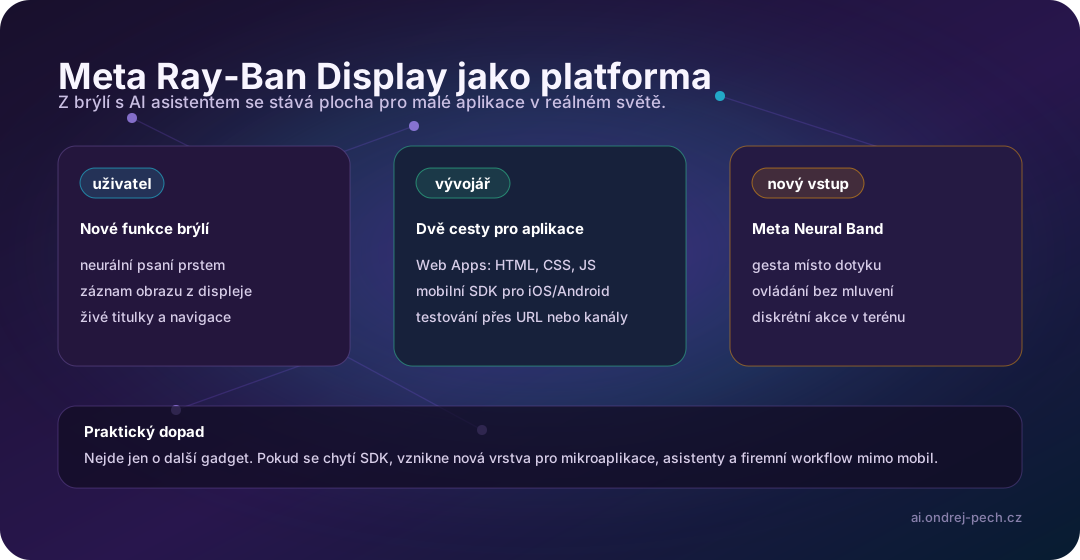
The point is not just that the glasses can show something in front of your eye. The important shift is that Meta is opening two development paths: extending existing iOS and Android apps through the Meta Wearables Device Access Toolkit, and standalone Web Apps built with HTML, CSS and JavaScript.
Why this is bigger than another pair of smart glasses
Wearables often fail at the platform layer. The hardware looks interesting, but development is either closed or too specific. That creates a nice demo device, not an ecosystem.
Here Meta is taking the opposite step. According to the official announcement, display access is currently in developer preview, but developers do not have to wait for a dev kit or imagine hypothetical hardware. The glasses already exist and Meta wants people to start testing now.
That matters especially for AI applications that do not make sense as large mobile apps: quick field assistance, contextual information before a customer meeting, a workflow step, translation, captions, a checklist, or a small interaction that should not require pulling out a phone.
Two paths: mobile SDK and web
The first path is for existing mobile apps. Meta added display capabilities to the Wearables Device Access Toolkit. Mobile developers can extend an iOS or Android app onto the glasses display using UI elements such as text, images, lists, buttons and video playback.
The second path is more interesting for fast experiments: Web Apps. Meta describes a standard HTML, CSS and JavaScript route without a proprietary framework. A developer can build a small app, preview it in the browser and deploy it to the glasses through a URL.
For the AI world, that is a meaningful change. Many useful agent tools are not big apps. They are small layers around data, workflow and context. If that layer can be built as a web mini-app, the glasses can become an output surface for internal agents, not just a consumer accessory.
Neural Band changes the input model
The display is only half the story. Meta is also building interaction around Meta Neural Band, which uses surface electromyography for subtle finger and hand gestures.
The practical impact is simple: users do not have to talk to the glasses, touch a phone or make obvious gestures. In work scenarios, discreet input can be more important than the display itself.
Think service technicians, logistics, healthcare, training, sales meetings or operations checks. An AI agent may prepare the next step, but the user needs a quiet “confirm”, “skip”, “save note” or “show detail”.
What I would test first
The first good use cases will not be large applications. They will be narrow tools that fit into a few seconds of attention:
- a live checklist for field work,
- captions and translation in a meeting,
- indoor or warehouse navigation,
- a quick CRM prompt before a conversation,
- order, invoice or service-step checks,
- a micro UI for an AI agent already running on a server.
This is where the web path makes sense: build a quick prototype, connect it to an existing backend and test whether information in the user’s line of sight truly helps.
The risk: glasses must not become notification hell
That is also the biggest warning. If glasses only move phone notifications in front of the eye, the product gets worse, not better. A display in your field of view is an extremely sensitive place. Every unnecessary interruption is more disruptive than a push notification.
A good AI glasses app has to be restrained. It should show only what the user needs right now, in a context where a phone or laptop gets in the way.
Bottom line
Meta Ray-Ban Display is not interesting only as new hardware. It is interesting because Meta is opening a developer surface for apps that live between mobile, web and the physical world.
If Web Apps and the Device Access Toolkit catch on, we may get a new layer of micro-apps for AI assistants. Not big apps users open, but small interfaces that appear at the right moment, show one thing and disappear again.
That is where AI wearables start to become practical.
Sources: Meta Developers: The wait is over: Build for display glasses starting today, Meta Wearables for developers, Marek Bartoš: Temný paradox AI. Proč tyhle chytré brýle už nikdy nesundáte.