SEO for AI: accessible websites agents can read and use
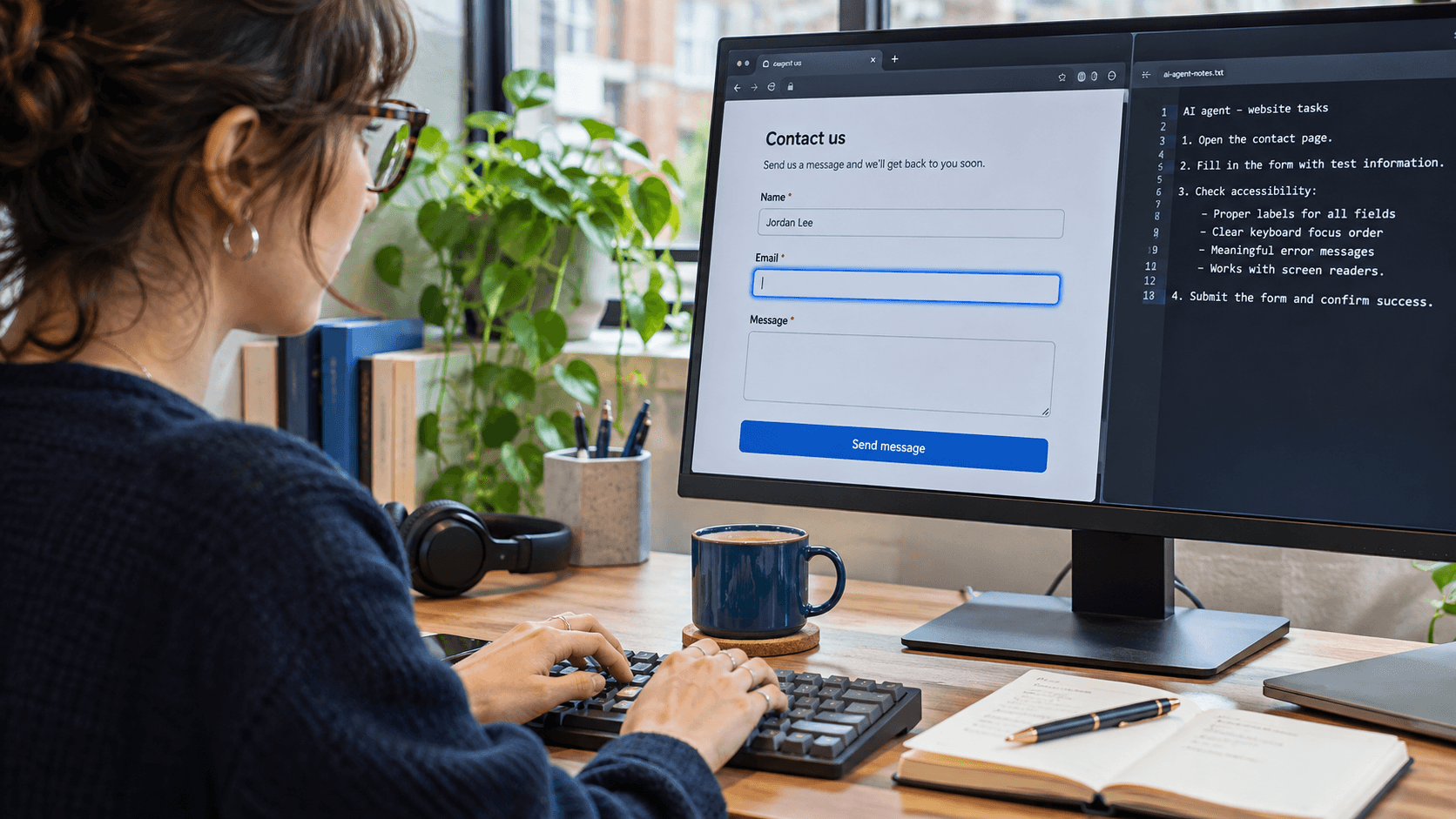
SEO for AI starts with a well-built website. In my view, sound SEO matters more than ever: pages are read by people, search engines and agents finding information or completing forms on someone's behalf. The foundations remain useful content, accessibility, clear structure and usable controls.
Google confirms that its generative search features build on SEO fundamentals. “More important” is my practical assessment, not a measured increase in a ranking factor. Adding an “AI file” does not automatically improve rankings.
Five priorities for a website AI can find and read correctly
I would use these five practices as an implementation order. The first four improve the website itself; the fifth offers a convenient alternative for tools that support it.
1. Make the content reachable
Key public pages should return their actual content with HTTP 200, be reachable through internal links and have no accidental noindex. Use real <a href="…"> links with descriptive text rather than JavaScript-only click handlers. A sitemap supplements a connected website; it does not replace one.
Check robots.txt and the CDN/WAF: a login or CAPTCHA screen can block a reading tool from otherwise public content. Distinguish search, training and user-triggered bots; discovery does not require allowing all training crawlers. Test: fetch a public URL without signing in and inspect the response and server logs. Changing a User-Agent alone does not authenticate a real crawler. Google: crawlable links, OpenAI bot overview
2. Put the answer in readable text with a logical structure
Explain early what the page addresses and who it is for. Make important facts available in HTML, not only in images, canvas or after several interactions. Use specific headings, natural paragraphs, ordered instructions and tables for genuine comparisons. There is no universal “AI paragraph length”.
Replace “great-value plan” with the price, currency, billing period, inclusions and limits. An agent then has less missing context to reconstruct across the site. Test: a text extract should correctly communicate the price, conditions and main conclusion. Bing recommends clear headings, examples, data and sources to support accurate use in AI answers. Bing: AI Performance
3. Keep information consistent, current and supported
Give each page a descriptive title, main heading and stable URL. Identify the canonical version of duplicates and connect language versions with correct hreflang. State the author, evidence for claims and the date of a genuine content update. Do not refresh the date daily just to look current.
Use Article, Organization or Product JSON-LD according to the actual page type and supported requirements. It must not advertise different prices or ratings from the visible page. Keep the pricing page, article and Markdown consistent. Test: three representations of the same offer should give the same answer. Accurate sitemap lastmod helps communicate changes; it does not promise another crawl. Google: sitemaps, Bing guidelines
4. Give controls meaning and make tasks work without a mouse
Use native buttons, links and labelled inputs. Provide meaningful image alternatives, proper headings, visible focus and understandable errors. Neither a blind user nor an agent should have to guess what an unnamed icon does or whether submission succeeded.
Test: complete an enquiry using Tab, Shift+Tab and the appropriate activation keys, then with a screen reader. Inspect element names and states in the accessibility tree. This provides concrete support for agents using that structure; it is not a ranking shortcut. The detailed checklist follows below.
5. Offer discoverable Markdown and measure its use
Keep good HTML and add a synchronised .md version served as text/markdown, an rel="alternate" declaration and a normal reader-facing link. Preserve the complete meaning, sources and working URLs; do not serve bots different claims from those shown to people. Negotiating through Accept is another option, not a requirement.
Test: compare both versions and log successful Markdown requests. Separate your own checks, verified bots and unverified User-Agents. Measure AI citations and referrals separately: a file's existence or download does not establish better recommendations.
Accessibility helps people and machines
Practices developed for blind users and screen readers have another application. Browsers expose an accessibility tree containing elements' roles, names and states. Automation tools can use this information: Playwright, for example, provides snapshots of that tree.
The practical benefit for agents using the DOM or accessibility tree is straightforward: they can identify a “Submit enquiry” button instead of guessing what a clickable rectangle means. For screenshot-only agents the benefit is less direct. Accessibility does not guarantee every agent will succeed; its primary purpose is serving people.
Here is what I would check:
- Structure: logical headings, regions such as
mainandnav, lists, data-table headers and the correct document language. Include a skip-navigation link. W3C: page structure - Images: informative images need meaningful
alttext; decoration getsalt="". Image buttons need a name describing their function. Give charts a text explanation or accompanying data when a short alternative cannot convey the information. W3C: images - Forms: a real
labelassociated with each input, suitable input types, clearly identified required fields and errors linked to the relevant controls. A placeholder is not a label. W3C: labels - Interaction: the entire task must work without a mouse. Tab and Shift+Tab move focus logically; Enter, Space and arrow keys behave as expected for the control. Focus must remain visible. Dialogs must not trap users, and closing one should restore focus to a sensible location.
- State and outcome: availability changes, errors and successful submissions must not rely on colour alone. Expose dynamic feedback to screen readers, for example with an appropriate
role="status". Prefer native HTML controls; add ARIA where needed.
In an enquiry form, this lets both a person and an agent identify missing information and confirm whether submission succeeded. The W3C forms tutorial and keyboard guidance are better starting points than another “AI plugin”.
Markdown: a useful second version
I also offer articles at the same address with a .md suffix. For example, this Czech article has a Markdown version.
A check on 3 November 2026 measured 121,333 bytes for the HTML response and 21,298 for Markdown — around 82% less. These are uncompressed response bodies, not measured token savings. A reading tool may already clean HTML itself.
Some bots demonstrably fetch Markdown. Dries Buytaert recorded 1,300 OAI-SearchBot requests for .md files in a month. GoodBarber also reported requests for nonexistent Markdown addresses before deployment. Neither finding proves the suffix produces more citations.
A sensible implementation:
- Generate HTML and Markdown from the same source and update them together.
- Return real Markdown with
Content-Type: text/markdown; charset=utf-8, retaining headings, links, image descriptions and important metadata. - Advertise the alternative in HTML instead of assuming a bot will guess:
<link rel="alternate" type="text/markdown"
      href="https://ai.ondrej-pech.cz/cs/blog/chatgpt-work-claude-cowork-pracovni-os.md">
- Also provide a regular “Read as Markdown” link. My inspected article lacked this connection in its HTML: a working endpoint is not automatically a discoverable endpoint.
- Optionally support
Accept: text/markdownon the original URL. Format negotiation requiresVary: Acceptand suitable caching so a browser does not accidentally receive Markdown. Vercel uses this approach.
Other useful improvements — and their limits
I would keep key facts, prices and terms available as text in the initial HTML. Structured data must match visible content. Check indexing, internal links, sitemaps and the firewall: robots.txt permission is ineffective if the server blocks the crawler.
Notify participating search engines of changes through IndexNow. A Strapi publication could trigger an n8n workflow announcing the changed Czech, English and Slovak URLs. This reports a change; it does not guarantee indexing.
Return correct HTTP statuses: 404 for missing pages, 429 for rate limits. APIs should expose understandable structured errors. Actual actions may justify an API or MCP tool with access controls and duplicate-submission protection. WebMCP points towards structured browser tools; on a blog, I would prioritise the basics first.
llms.txt can be a directory for tools that support it. It has no established universal ranking benefit in AI answers. Markdown is not a ranking shortcut either: Profound's experiment on 381 pages found no statistically significant increase in bot visits. It measured visits, not citations.
What happens when ten agents read the same archive?
Opening a parish register in a browser puts little pressure on an archive. Ten agents paging through hundreds of scans can change that quickly. On 2 November, version 0.6.0 of rodokmen-skill, a Czech genealogy project for Claude Code, introduced a request limit shared by all processes on the same computer. Each archive gets its own allowance. The downloader can pause for half an hour when the archive signals overload. Project changelog · AI Mastermind discussion
The same issue comes up when several n8n jobs pull company details from one directory into a CRM. A delay in each job still allows the requests to pile up. Queue requests by source, cache pages that multiple jobs need, and pause that source’s queue on a 429 response, respecting the server’s Retry-After header when present. Run two imports together and check the request log to see whether their combined traffic stays within the limit.
Start by completing a task without a mouse
Choose three tasks: find a price, understand the offer and submit a test enquiry. Run them with a keyboard, a screen reader and your chosen agent. Combine automated audits with manual checks; none of these tests alone establishes full accessibility.
Fix obstacles first. Then add Markdown discovery and measure verified bot requests, citations, visits and completed enquiries separately. A file download is not a recommendation.
I expect the direction to be useful content, accessible interfaces and explicit tools for actions. Preparing for AI agents starts with making a website work for people — including those who cannot see it or do not use a mouse.