Google I/O 2026 beyond Gemini 3.5 Flash: Google is turning AI into an agent layer

Google I/O 2026 is easy to reduce to one new model. That would miss the point. I already covered Gemini 3.5 Flash separately, and Gemini Spark deserves its own article because it points toward a personal agent that runs continuously. The rest of I/O is most useful when read together: Google wants to move AI out of the chat box and into Search, Workspace, development, shopping, video and content provenance.
This is not one product. It is a change in the layer where AI sits.
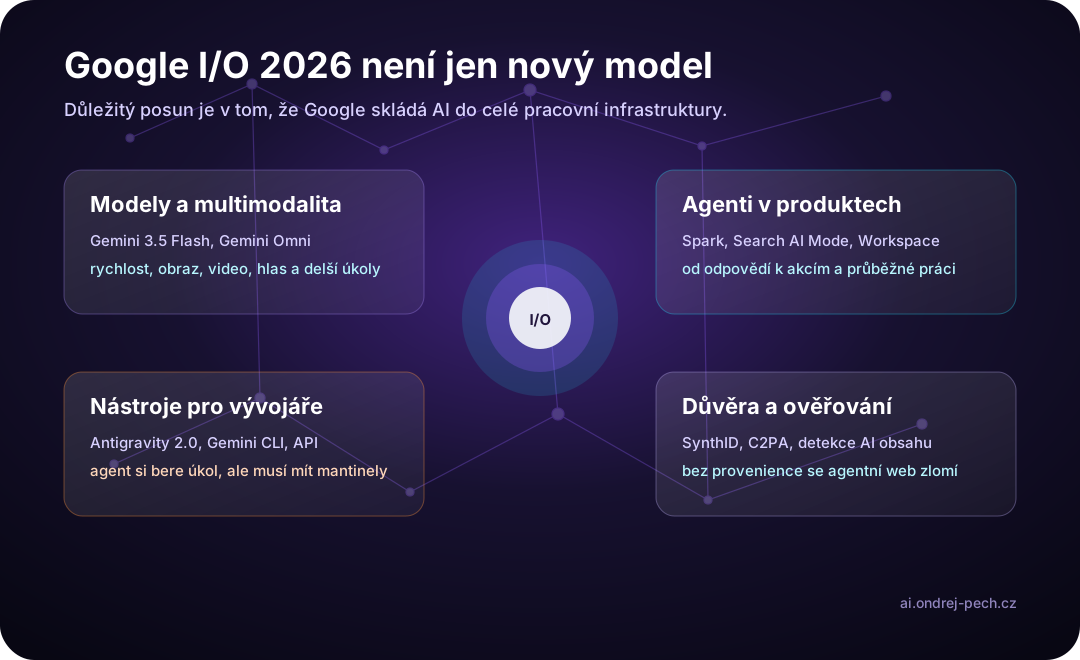
The key shift: AI is becoming a work environment
Google built I/O around several directions at once. Gemini 3.5 Flash handles fast, comparatively practical API work. Spark moves Gemini toward a personal agent that can keep context and work across Gmail, documents, calendar and tasks. Gemini Omni and creative tools such as Flow point toward deeper multimodality. Search AI Mode, Workspace and developer tools give AI distribution: inside the places where people already work.
For companies, that matters more than a single benchmark table. You can replace a model. Replacing the distribution layer, permissions, audit trails and user habits is much harder.
Gemini Omni: a strong signal for multimodal work
I would not treat Gemini Omni as something that replaces every API workflow tomorrow. It is more a signal of direction: AI that combines text, image, sound, video and interaction more naturally inside the product experience.
Typical use cases are video preparation from source materials, interpreting visual assets, working over presentations, fast creative prototyping, review of visual variants or multimodal research. This is where the gap between a text chatbot and a truly multimodal system starts to matter.
The weakness is the usual one for creative AI: the output can look convincing before it is factual, licensed or brand-safe. Marketing and product teams still need source checks, approval flows, brand rules and clear policies for generated media.
Search AI Mode: less searching, more delegation
Google Search keeps moving from a list of links toward a mode where AI can break down questions, suggest next steps and sometimes behave like an information agent. That is convenient for users and disruptive for the web.
If AI answers directly inside Search, some visits never reach the original website. At the same time, specific, useful and well-sourced content becomes more valuable. For company blogs, this means fewer generic “what is AI” articles and more concrete experience, comparisons, tutorials, numbers and practical examples.
For this AI blog, that is actually good news. Practical articles with sources, setup notes and real tradeoffs have a better chance than generic SEO filler.
Workspace Live and agents inside documents
Workspace updates are less spectacular than a new model, but probably more important for companies. If AI sits directly in Gmail, Docs, Sheets and meeting materials, the workflow changes. The question becomes less “what prompt should I write” and more “what should happen with this email, note, spreadsheet or contract”.
That is where real savings can appear: inbox triage, draft replies, meeting summaries, document checks, converting notes into tasks and preparing internal materials. It is also where permissions matter. An agent that can see Gmail and Drive is not just a nicer chatbot. It is a new internal actor with access to company data.
Gemini 3.5 Live Translate: translation as another work layer
On June 9, 2026, Google released Gemini 3.5 Live Translate. This is not just another mode in Google Translate. The model provides near real-time speech-to-speech translation, automatically detects more than 70 languages and tries to preserve intonation, pacing and pitch while translating continuously. Google is rolling it out through the Gemini Live API and AI Studio for developers, private preview in Google Meet for enterprises and Google Translate on Android and iOS.
Practically, this fits the same map of agentic infrastructure. Translation is no longer only a separate app where someone manually pastes text. It becomes a layer for meetings, support, onboarding, training, sales calls and internal communication across offices. I would not use it as a replacement for interpreters in legal or sensitive meetings. I would use it as an operational layer: understand the customer, get a first meeting summary, bridge routine communication and send important outputs to human review.
For automation, the API is the important part. In n8n or Make, this can become a pipeline: meeting audio or stream, live translation, summary in the team language, task extraction and write-back to CRM or helpdesk. The guardrails are consent, audio retention, translation accuracy and clear labeling of what becomes an official work record.
Antigravity 2.0 and Gemini CLI: developer agents beyond the editor
The developer announcements fit the same pattern. Antigravity 2.0, Gemini CLI and deeper Gemini integrations show that Google does not want to be only an API model provider. It wants to be the layer for assigning, planning and executing development tasks.
That is interesting for teams already using Claude Code, Cursor, Codex or internal agents. Google’s advantage is that it can connect model, cloud, documentation, repository, terminal, observability and company identity. The weak points are familiar: reliability on longer tasks, understanding existing architecture, tests, reviews and permission boundaries.
I would put this into pilots, not blind trust. Let the agent prepare a change, write tests and read documentation. Production merges should still go through review.
Gemini for Science: AI as a scientific workbench
Google I/O had one more branch that can easily get lost between models and agents: Gemini for Science. On May 20, 2026, Google introduced a set of experimental science tools in Google Labs, built around Co-Scientist, AlphaEvolve, ERA and NotebookLM.
The important point is not to overstate it. This is not “AI replaced scientists”. It is a work layer for parts of scientific work that are slow today: literature synthesis, hypothesis generation, computational experiment design, paper comparison and research artifacts. Google also points to Nature validation papers for Co-Scientist and ERA, so this is more than a keynote demo.
Practically, I would read it this way: for pharma, materials research, bioinformatics and academic teams, AI is moving from “chat over a paper” into a more specialized research environment. Human control, experimental validation and source traceability still matter. AI can speed up hypothesis search. It does not automatically produce good science by itself.
This extends the main point of the article: Google is not only putting AI into office work, development and search. It is also trying to make AI a layer for research. And the rules there will be stricter than for ordinary company agents: citations, reproducibility, validation and accountability.
Universal Cart and shopping: the agent will not only advise
Shopping updates such as Universal Cart show the move from answering to acting. AI should not only explain product differences. It should help choose, check availability, compare options and move the process closer to purchase.
For e-commerce, that is a big deal. If part of the decision moves into an assistant, a polished product detail page is not enough. Structured data, availability, parameters, reviews, pricing, delivery and trustworthy product information become crucial.
SynthID and C2PA: agentic web needs provenance
Google is also strengthening AI content identification through SynthID and standards such as C2PA. That may sound like a side topic, but it belongs at the center of an agentic internet. The more AI generates images, video, audio and text, the more important it becomes to know where output came from and whether it was edited.
Companies should start tracking what they generate with AI, where they publish it, what rights they have and how they mark synthetic content. Not for moral theater, but for reputation, legal certainty and future platform rules.
What I would do in a company now
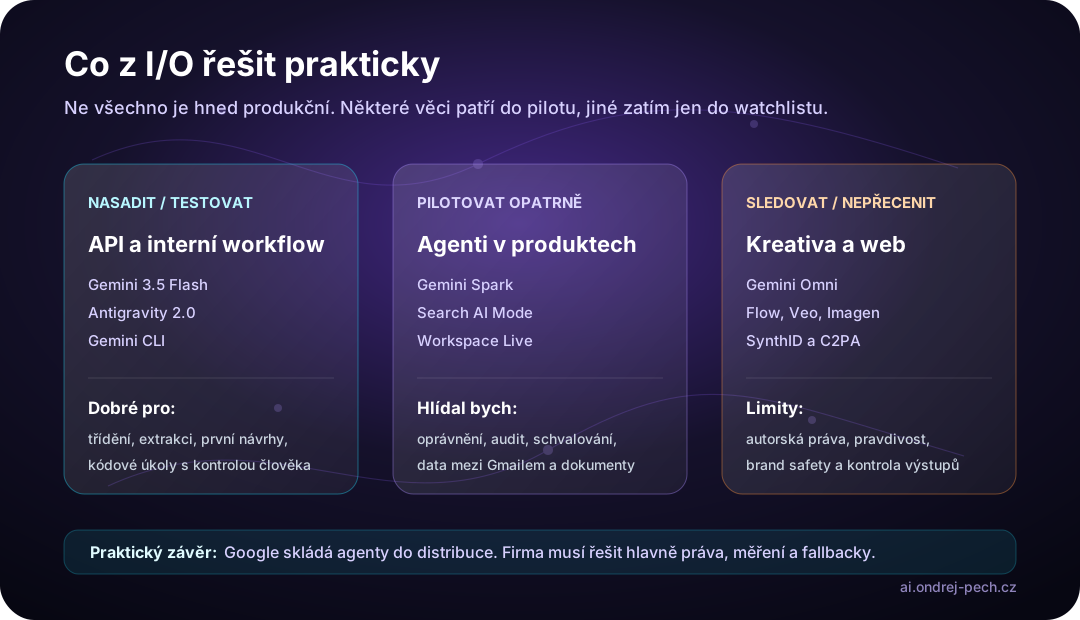
The sensible move is not “turn on everything from Google”. I would split it into three layers.
First: API and internal workflows. Gemini 3.5 Flash is worth testing for triage, extraction, first drafts, internal research, meeting translation through Live Translate and automations in n8n or Make. This layer can be measured: cost, speed, error rate and ROI.
Second: product agents. Spark, Workspace Live and Search AI Mode should be piloted with explicit permissions. Who can the agent see, what can it do alone, what needs human approval and where is the audit trail?
Third: creative and public content. Gemini Omni, Flow, Veo, Imagen and SynthID are useful for prototypes, storyboards, campaign drafts and quick visual variants. Public publishing still needs checks for rights, facts, brand safety and AI labeling.
Practical takeaway
Google I/O 2026 matters not because Google showed one more model. It matters because Google is building AI into the layer above everyday work: search, email, documents, meetings, translation, development, shopping, video and content verification.
Gemini 3.5 Flash deserved its own article because we have performance, pricing and independent benchmarks. Spark deserved its own piece because it is a clear signal of a 24/7 personal agent. The rest of I/O makes most sense as a map of agentic infrastructure.
The real difference between companies will not be who has the flashiest demo. It will be who has processes, permissions, measurement and human control.
Sources
- Google: Gemini 3.5, Gemini Omni and more updates from Google I/O 2026
- Google: Fluid, natural voice translation with Gemini 3.5 Live Translate
- Google: Google AI Ultra and updated AI subscriptions
- Google Search: AI updates from Search at I/O 2026
- Google Developers: Developer highlights from Google I/O 2026
- Google Workspace: Workspace AI updates from I/O
- Google: How Google is making it easier to understand AI-generated media
- Google: Gemini for Science: AI experiments and tools for a new era of discovery
- Google Research: A New Era of Innovation: Google Research at I/O 2026
- Nature Portfolio: AI research assistants that may accelerate scientific discovery
- Zaujaloma AI: Google vylepšil AI prekladač